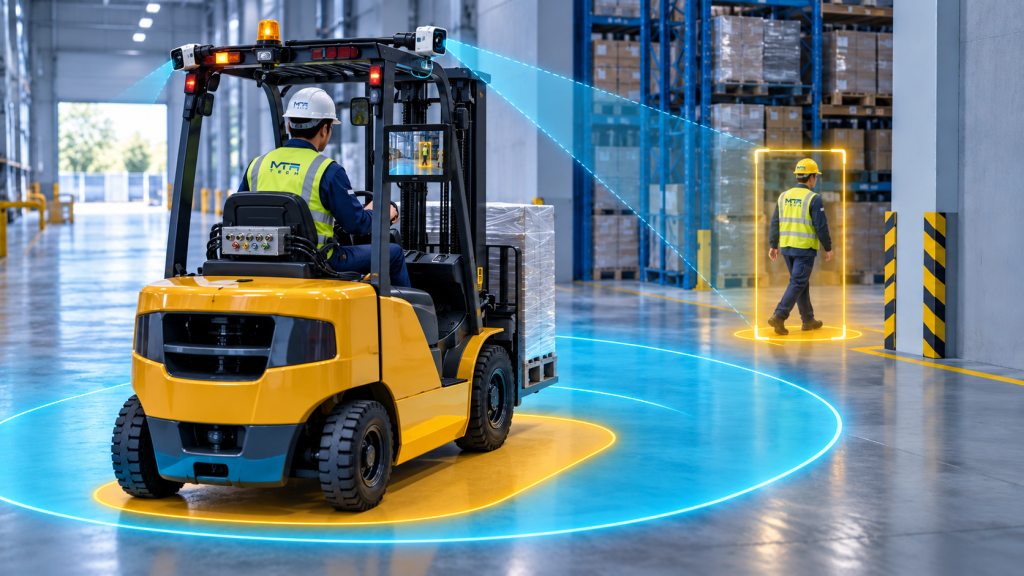
At an intersection between a pedestrian walkway and an internal transport route, a forklift is moving a pallet from the warehouse to the production area. At the same time, an employee steps into the forklift’s path from an adjacent aisle.
The operator must monitor the direction of travel, the load, and surrounding traffic simultaneously. Meanwhile, the pallet, the forklift structure, or a blind corner at the intersection may prevent the operator from seeing the pedestrian. Whether the forklift is moving forward, reversing, or turning, even a brief moment in which the two parties fail to see each other can create a collision risk.
This is a familiar situation in factories and warehouses, where employees, forklifts, and other equipment operate within the same busy environment.
MULTIPLE SAFETY MEASURES ARE ALREADY IN PLACE, BUT GAPS REMAIN
Companies commonly combine several measures to reduce the risk of collisions between forklifts and pedestrians. Each measure is necessary, yet each has certain limitations:
-
Dedicated traffic lanes and floor markings: These help guide pedestrians and forklifts, but they cannot actively detect or warn when someone accidentally enters a hazardous area.
-
Warning signs and convex mirrors: These improve visibility at certain fixed intersections, but their effectiveness depends on installation position, viewing angle, and user attention.
-
Horns, warning lights, and reversing alarms: These indicate that a forklift is operating, but the sound may be masked by machinery noise and often does not identify the direction from which the risk is approaching.
-
Speed limits and operating procedures: These help reduce risk, but their effectiveness still depends on compliance, operator visibility, and reaction time.
-
Regular safety training: This improves awareness but cannot entirely eliminate fatigue, distraction, or delayed reactions during a work shift.
-
Safety barriers, guardrails, and access gates: These provide effective physical separation at fixed locations but may not cover every area where traffic patterns change frequently.
These measures remain the foundation of factory safety. However, one important gap remains: the ability to detect an emerging hazard and issue a warning at the right moment.
FROM PASSIVE WARNINGS TO PROACTIVE SAFETY WITH AN AI CAMERA SYSTEM
Rather than simply generating a general warning whenever a forklift is operating, a proactive safety system should answer three key questions:
-
Is a pedestrian entering the forklift’s operating area?
-
Where is the person located, and how close are they to the vehicle?
-
How can the operator be warned early enough before the distance becomes dangerous?
This is the challenge that the VIA Mobile360 Forklift Safety System is designed to address.
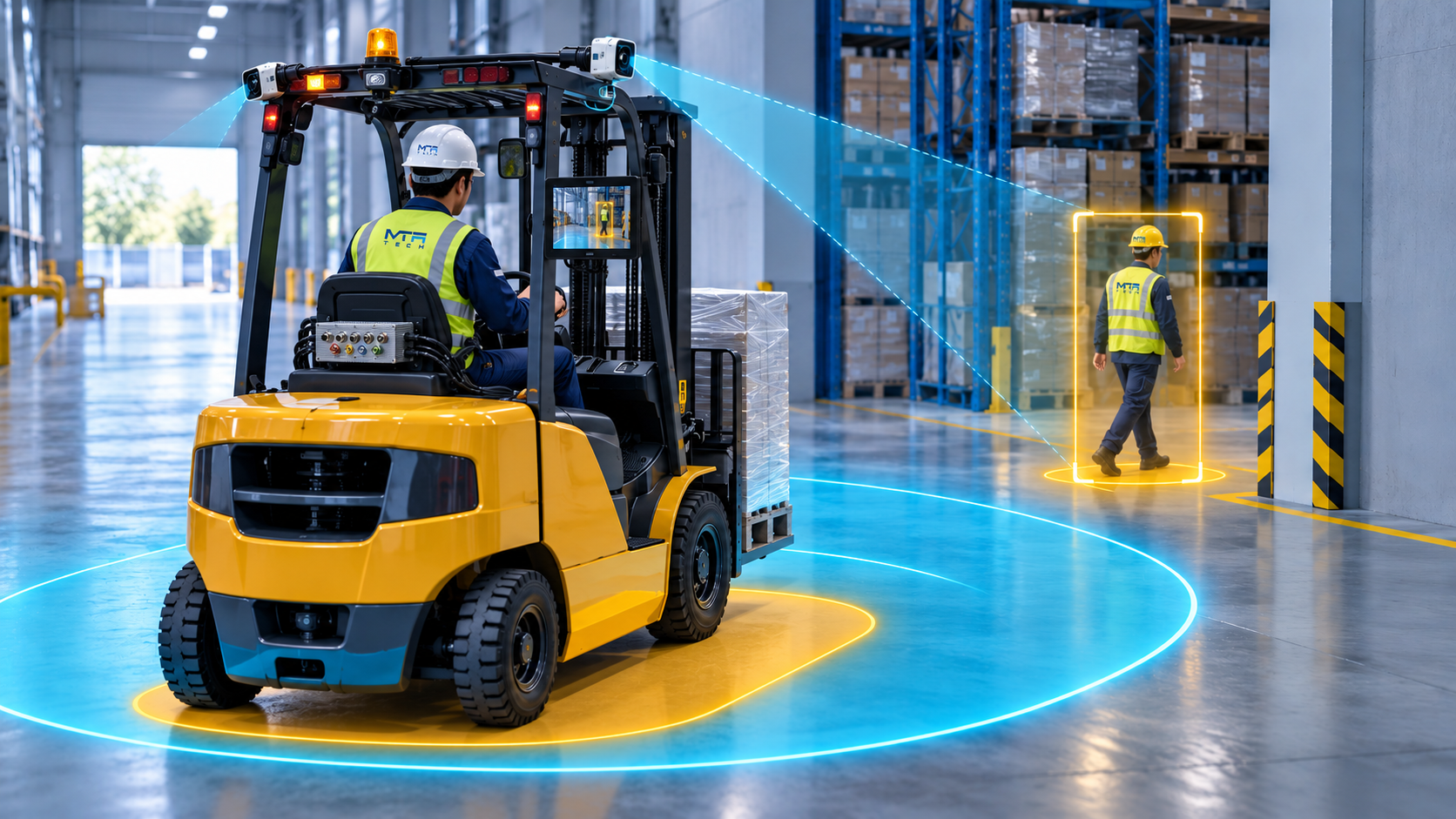
Using AI-powered cameras, the system detects pedestrians within configured zones and alerts the operator as soon as a person enters a risk area. Because the cameras are installed directly on the forklift, they can supplement the operator’s view in areas that are difficult to observe when the vehicle is moving forward, reversing, or turning.
KEY FEATURES OF THE VIA AI CAMERA SOLUTION
Pedestrian Detection Without Wearable Tags
VIA’s AI cameras recognize the human form directly through visual analysis, without requiring employees to wear RFID tags or carry separate transmitting devices.
The system can detect people in different positions, including standing, walking, bending, kneeling, or sitting low—situations that may be difficult to notice in a busy factory or warehouse.
Configurable Detection Zones
Detection areas can be calibrated according to the forklift and its operating environment. Companies may configure a single alert zone or multiple alert levels to notify operators as the distance between the forklift and pedestrian decreases.
Situation-Specific Visual and Audio Alerts
When a person is detected within a configured zone, the system provides visual and audio alerts. An in-cabin display can help the operator identify where the risk is coming from, providing additional time to observe and respond.
Optional Driver Safety Monitoring
In addition to pedestrian detection, the VIA solution can be expanded with driver monitoring capabilities. The optional driver monitoring system can help detect signs of fatigue and unsafe behaviours, including mobile phone use or smoking while operating the vehicle.
VIA AI cameras do not replace safety training, traffic separation, speed limits, barriers, or forklift operating procedures. Their value lies in adding a proactive layer of protection: continuous monitoring, hazard detection, and early warning for the operator.
How does the system perform pedestrian detection under real operating conditions? How should warning zones be configured? Which camera arrangement is suitable for different forklift types and factory environments?
DISCOVER THE VIA AI CAMERA SOLUTION WITH MTA TECH AT AUTOTECH CAFÉ NO. 4
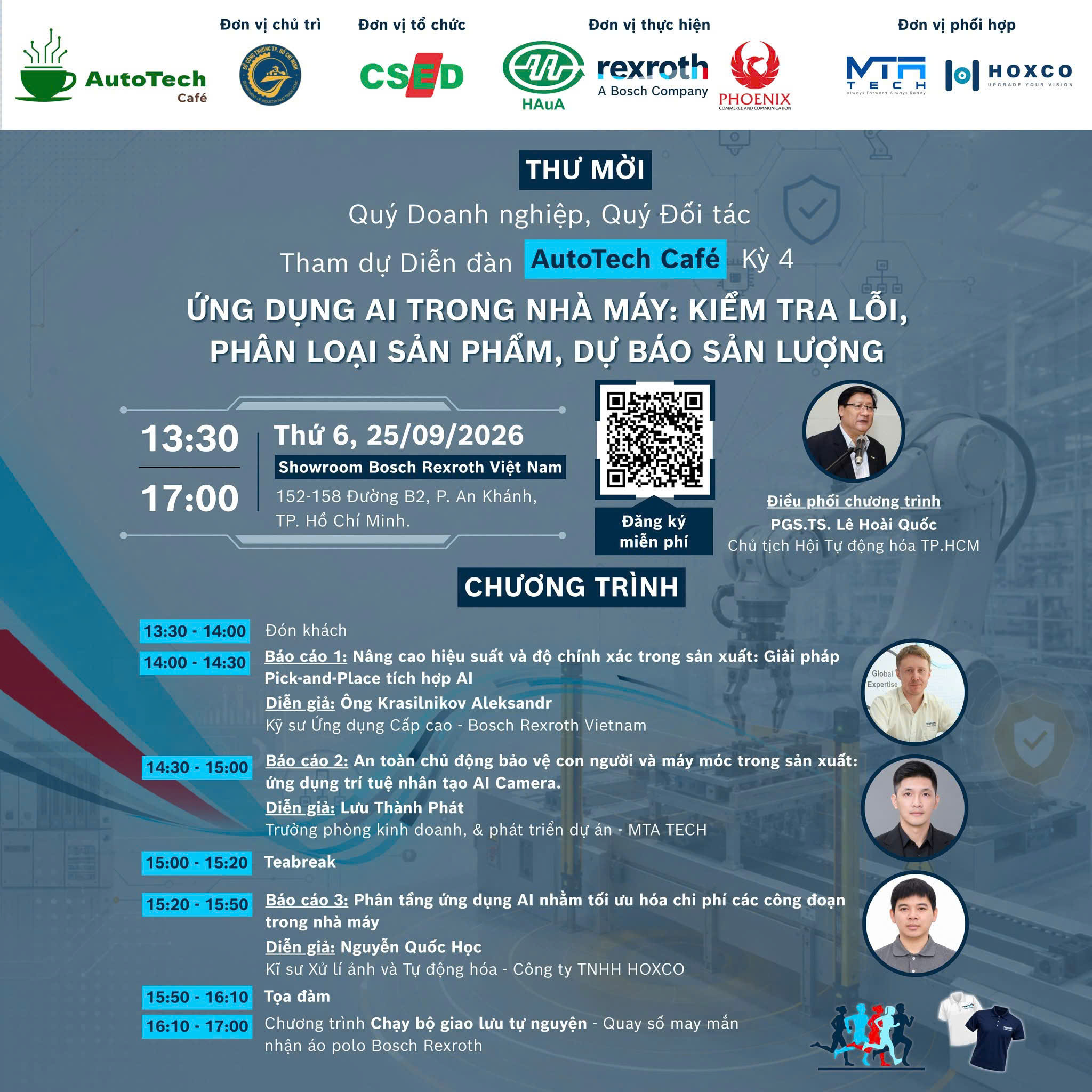
At AutoTech Café No. 4 – “AI Applications in Factories: Defect Inspection, Product Classification, and Production Forecasting,” Mr. Lưu Thành Phát – Sales and Project Development Manager at MTA TECH will present the topic:
“Proactive Safety for People and Machinery in Manufacturing: Applying AI Camera Technology.”
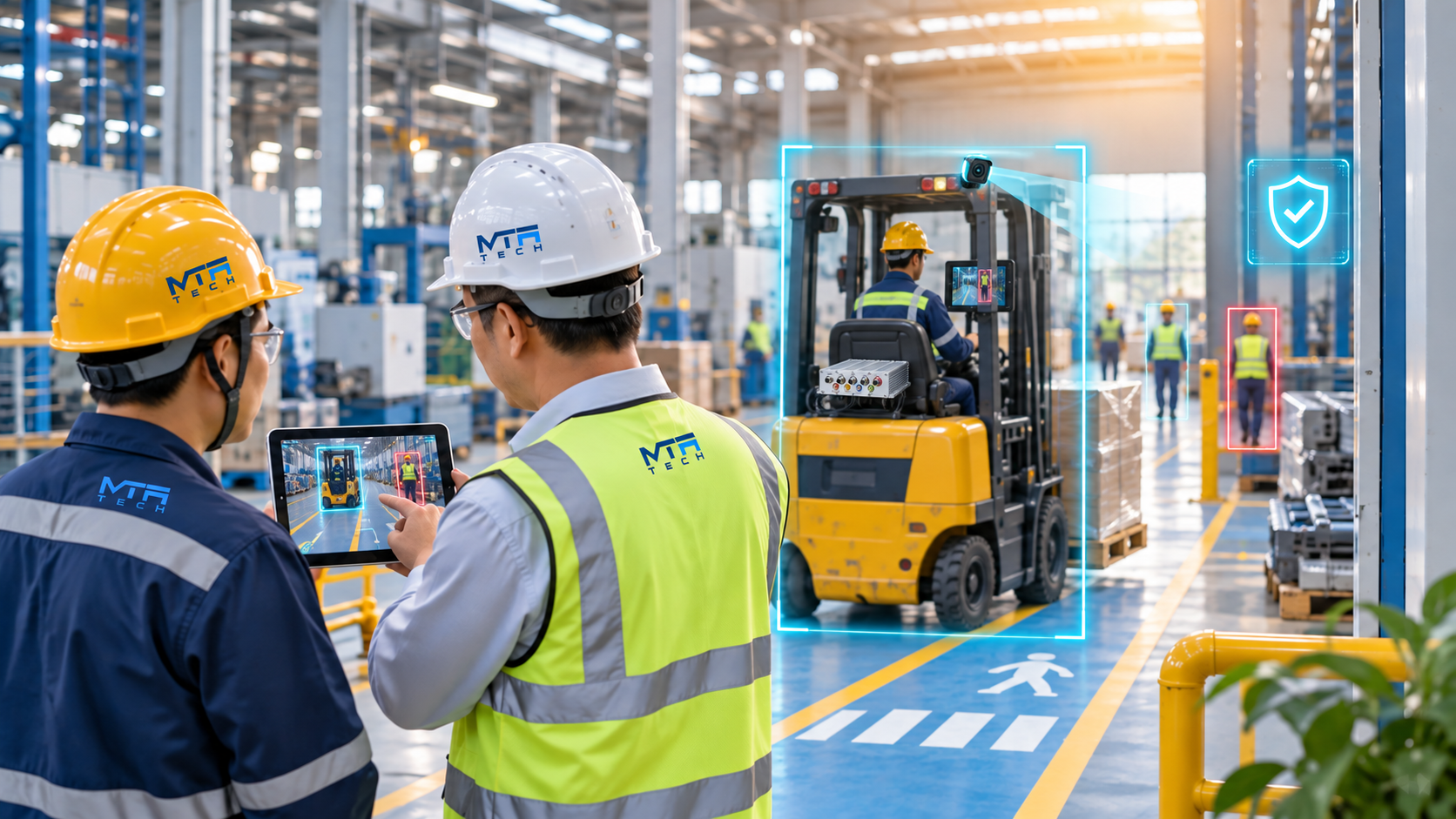
Through practical operating scenarios, the presentation will provide businesses with a clearer understanding of pedestrian detection, warning-zone configuration, and the potential application of VIA AI Camera solutions in factory environments.
Event Information
-
Event time: 1:30 PM–5:00 PM, September 25, 2026.
-
MTA TECH presentation: 2:30 PM–3:00 PM.
-
Speaker: Mr. Lưu Thành Phát – Sales and Project Development Manager, MTA TECH.
-
Venue: Bosch Rexroth Vietnam Showroom, 152–158 B2 Street, An Khánh Ward, Ho Chi Minh City.
If your company is looking for a solution to reduce forklift blind spots, improve pedestrian alerts, or strengthen forklift operating safety, join MTA TECH at AutoTech Café No. 4 to learn more about the VIA AI Camera solution and discuss the specific safety challenges in your facility.