DIFFERENCES BETWEEN TRADITIONAL INDUSTRIAL FANS AND HVLS INDUSTRIAL CEILING FANS – MTA TECH
In an era characterized by robust industrial growth, the demand for industrial fans has seen a notable increase. Specifically, within factories, workshops, and industrial zones, industrial fans are essential devices for regulating temperature, enhancing ventilation, and reducing humidity. However, technological advancements have led to the emergence of innovative industrial fan products with significant enhancements, namely HVLS (High Volume Low Speed) industrial ceiling fans. When faced with the choice between traditional industrial fans and HVLS industrial ceiling fans for their factories, workshops, or industrial spaces, users often find themselves pondering the distinctions between the two. In this article, let MTA TECH shed light on the disparities between traditional industrial fans and HVLS industrial ceiling fans.

Industrial fans and HVLS industrial ceiling fans exhibit significant distinctions.
1. Unique Design Features of HVLS Industrial Ceiling Fans
Traditional industrial fans are typically small and come in various types, such as table fans, wall fans, exhaust fans, and ventilation fans. These fans operate at high speeds, generating strong but localized airflow in specific areas. As a result, they fail to ensure even air circulation and do not effectively reduce humidity levels. Achieving effective cooling in large spaces with traditional fans often requires the installation of multiple units.
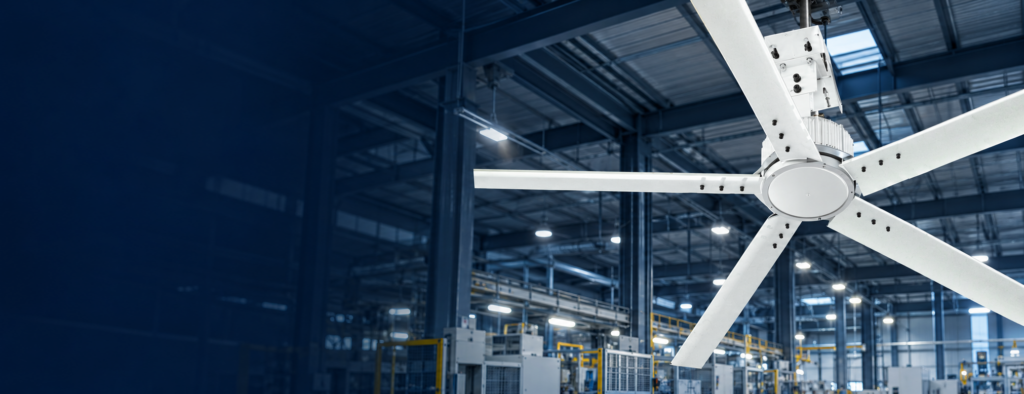
On the other hand, MTA TECH’s HVLS ceiling fans boast large dimensions, typically ranging from 2.5 to 7.2 meters, and are installed on ceilings. They operate at lower speeds, producing expansive airflow that uniformly disperses throughout the entire space. In fact, just one HVLS fan can efficiently cool an extensive area of up to 2000m2. Consequently, HVLS fans enhance ventilation, reduce humidity, and maintain a comfortable and productive working environment.

One HVLS fan – MTA TECH corresponds to 65 traditional industrial fans
Traditional industrial fans are typically designed with numerous blades and high rotational speeds, utilizing a gearbox motor to generate air circulation. However, the operation of these fans often leads to vibration and friction between components, resulting in noise generation and elevated temperatures, which in turn increase energy consumption and reduce overall performance.
In contrast, MTA TECH’s HVLS fans employ a PMSM (Permanent Magnet Synchronous Motor) gearless motor paired with a large impeller that boasts a substantial surface area. While these fans rotate at lower speeds, they produce a substantial airflow. The absence of friction between components allows HVLS fans to operate smoothly, significantly saving energy and enhancing overall efficiency. In fact, a single HVLS fan from MTA TECH can deliver the same performance as 65 traditional industrial fans while reducing monthly electricity bills by up to 90%.
2.1 Noise
HVLS fans from MTA TECH operate quietly, producing minimal noise levels (≤ 39dB). This feature enhances the comfort and well-being of users. In contrast, traditional industrial fans often generate loud noise, causing discomfort to workers.
2.2 Safety of HVLS Industrial Ceiling Fans
Traditional industrial fans typically have fast rotations and sharp blades, posing risks to workers if safety protocols are not adhered to. On the other hand, MTA TECH’s HVLS fans feature specially designed fan blades constructed from aluminum alloy, resembling miniature airplane wings. Coupled with a slow operating mechanism, these fans prioritize employee safety. Furthermore, HVLS fans incorporate a 3-layer safety mechanism and an anti-vibration system, minimizing the chances of falling or breakage. Notably, HVLS industrial ceiling fans from MTA TECH are equipped with an overload protection system, reducing the risk of fires and explosions, providing peace of mind to workers below.
2.3 Cost and Maintenance
Traditional industrial fans typically come with lower initial price tags compared to HVLS fans. However, they require regular maintenance and oil changes to prevent accidents. Moreover, the lifespan of traditional industrial fans is limited, ranging from 3 to 5 years.
In contrast, the initial investment for HVLS long-blade ceiling fans from MTA TECH is higher than that of traditional industrial fans. Nonetheless, due to the implementation of PMSM gearless motors, HVLS fans entail no maintenance costs, and their lifespan extends up to a remarkable 10 years. This extended lifespan ultimately contributes to cost savings in the long run.
In summary, the distinctions between traditional industrial fans and HVLS industrial ceiling fans from MTA TECH are quite evident. HVLS fans offer superior features, including energy efficiency, maximum airflow, low noise, and the capacity to uniformly distribute air throughout large spaces, making them an ideal choice for industrial projects, warehouses, or expansive areas that require optimized ventilation systems. On the other hand, traditional industrial fans may be better suited for smaller spaces with lower initial investment costs. However, when considering the overall cost of operation, long-blade industrial ceiling fans prove to be a more intelligent choice due to their high operational efficiency and extended lifespan. Therefore, if you are seeking a comprehensive ventilation solution for your facility, HVLS fans – a high-quality product from MTA TECH – warrant serious consideration.
———————–
MTA TECH CO.,LTD – Nhà cung cấp giải pháp công nghiệp tin cậy
VP HCM: Số 19 đường 12 – Cityland Park Hills, 18 Phan Văn Trị, Phường 10, Quận Gò Vấp, TP. HCM
VP HN: Lâm Viên Complex, 107 Nguyễn Phong Sắc, P. Dịch Vọng Hậu, Q. Cầu Giấy, TP. Hà Nội
Hotline: 098 234 7975 | www.mtatech.com | sales@mtatech.com