Rising Temperatures Are More Than a Comfort Issue
The hot season has officially begun. Outdoor temperatures are climbing past 35°C. Inside factories—especially those with metal roofs and ceiling heights of 6 to 10 meters—the actual working temperature can be 3–7°C higher.
This is not just about discomfort.
It is about how heat silently impacts productivity, operational costs, equipment lifespan, and workforce stability.
For manufacturing leaders, the hot season is not a weather event.
It is an operational stress test.
What Happens to a Factory When Temperatures Exceed 32–35°C?
When indoor heat rises beyond the optimal range, several issues begin to surface:
-
Workers fatigue faster and require longer recovery breaks
-
Focus and precision decline, increasing defect rates
-
The likelihood of workplace incidents rises
-
Machinery operates under thermal stress, reducing long-term reliability
-
Cooling devices run continuously, driving electricity consumption upward
These losses rarely appear clearly in financial statements.
Yet by year-end, the impact on profitability is measurable.
Heat does not stop production.
It gradually erodes performance.
The Hot Season Exposes Management Strategy
Factories typically respond in one of two ways:
Reactive approach:
Wait until workers complain and productivity drops, then implement temporary solutions.
Proactive approach:
Assess airflow design, ventilation efficiency, and cooling systems before peak heat and peak production overlap.
The difference is not temperature.
It is leadership mindset.
High-performing factories do not allow seasonal heat to dictate output stability.
Why High Ceilings Alone Do Not Solve the Heat Problem
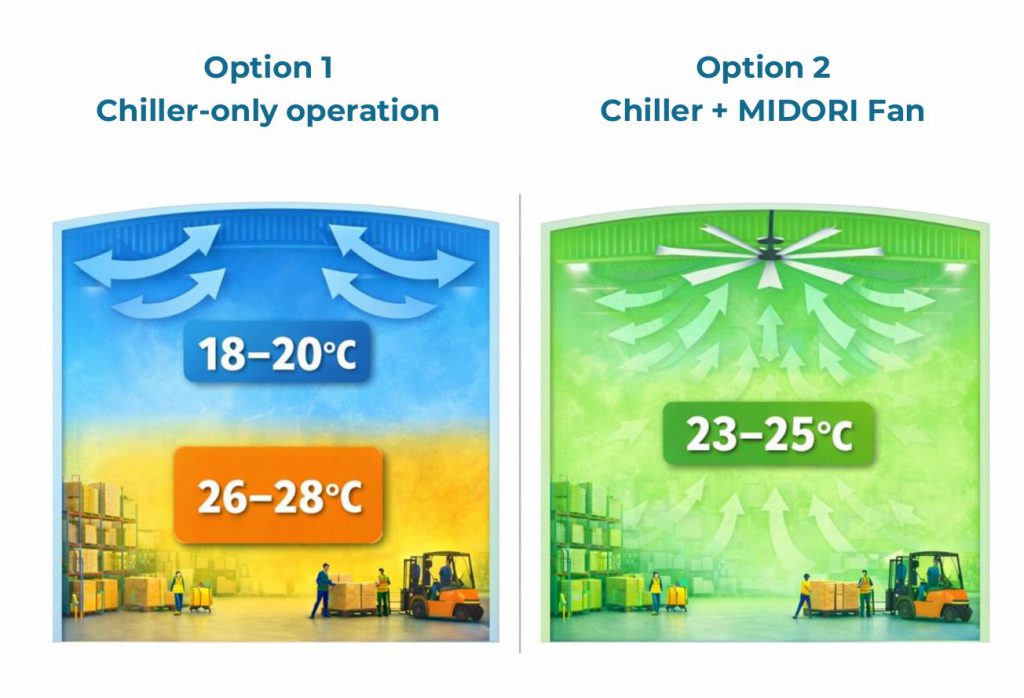
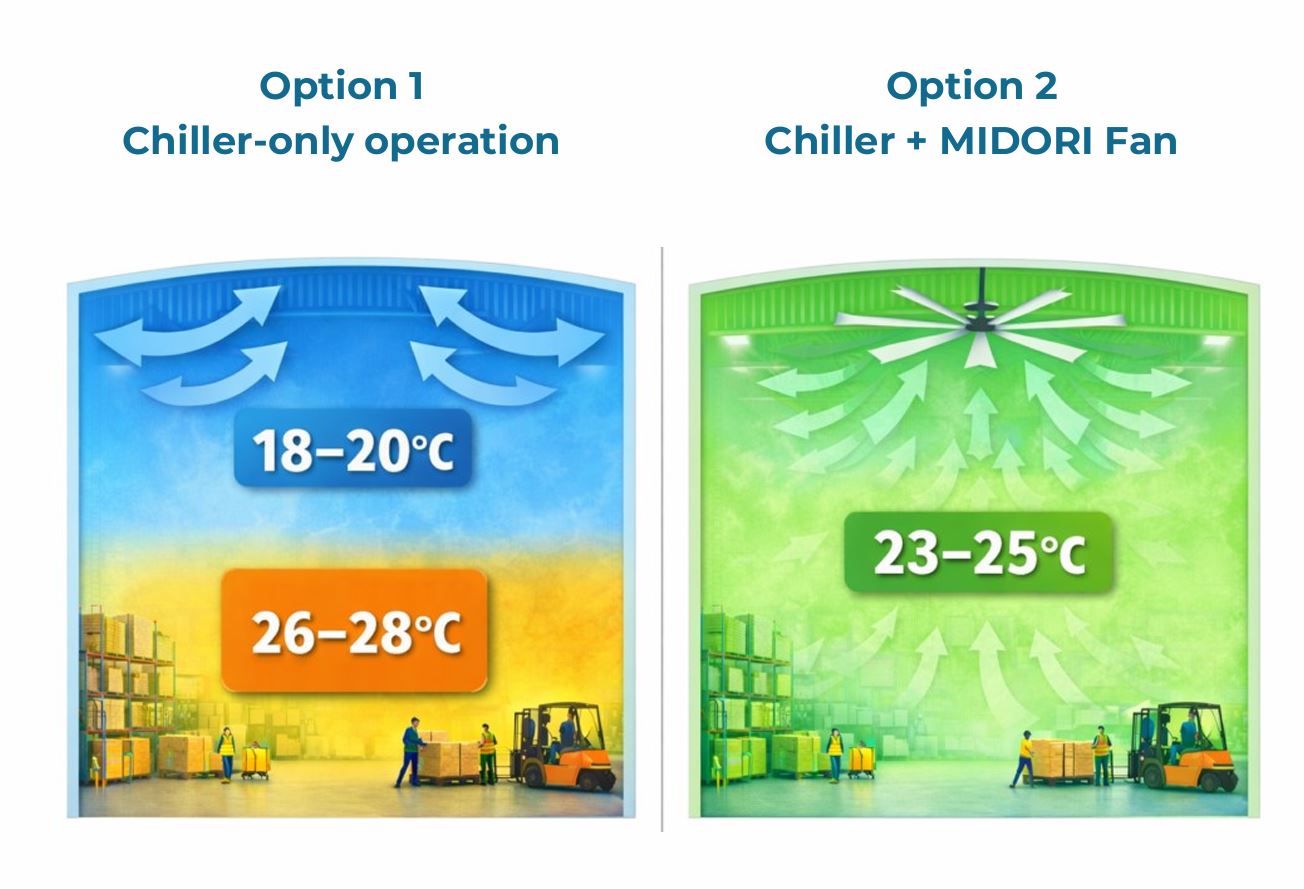
Many assume that tall buildings naturally stay cool. In reality, hot air rises and accumulates near the roof, creating a thermal layer that traps heat above the workspace.
Conventional small industrial fans push air horizontally but often fail to break this accumulated heat layer effectively.
The result:
-
Working zones remain uncomfortable
-
Upper air volume becomes wasted space
-
Electricity usage increases without proportional cooling benefits
The challenge is not fan quantity.
It is airflow engineering.
Effective cooling requires strategic air circulation that redistributes trapped heat and stabilizes temperature across the entire workspace.
Factory Cooling: Seasonal Cost or Strategic Investment?
Cooling systems are often viewed as temporary expenses during summer months.
However, when properly designed, a factory-wide cooling strategy can:
-
Stabilize productivity during peak seasons
-
Reduce defect rates linked to worker fatigue
-
Lower electricity waste from inefficient patchwork solutions
-
Improve employee retention in competitive labor markets
At that point, cooling is no longer a seasonal cost.
It becomes an operational investment with measurable returns.
Prepare Before Peak Heat Meets Peak Production
The hot season has just started. In many industries, peak production periods align with the hottest months of the year. Waiting until discomfort becomes disruption is rarely the optimal strategy.
The critical question for decision-makers is:
- Is your factory prepared with an optimized cooling system designed for industrial-scale efficiency?
- Or are you relying on short-term fixes that may cost more in the long run?
Operational resilience begins with preparation and summer is already here.
???? Hotline: +84 98 234 7975
✉️ Email: sales@mtatech.com
???? Website: www.mtatech.com
???? MTA TECH – A Pioneer in Industrial Cooling, Safety & Factory Automation Solutions in Vietnam.